
Prologue
The Question That Started Everything
A fluent answer feels like comprehension, even when no understanding took place.
Think first
Think of the last time an AI answer impressed you. What specific signal made you feel it had understood you?
Roger Basler de Roca · thinkRoger
AI systems do not understand us. They simulate understanding, and we rarely notice the difference.
Before anything else: how many phone numbers do you know by heart?
Chapter Map
Select any node on the brain-circuit diagram to read the chapter thesis, pause on a 'Think first' question, and open the full chapter overview.
Prologue
A fluent answer feels like comprehension, even when no understanding took place.
Think first
Think of the last time an AI answer impressed you. What specific signal made you feel it had understood you?
Interactive Test · 6 Rounds
Read six short, plausible AI-style statements. Decide whether each shows genuine understanding or fluent pattern-matching, and spot the subtle error before seeing the explanation.
Self-Assessment · 8 Questions
Check how much of your drafting, verification, and framing you currently hand over to AI. Get your cognitive profile and one practical step from the CARE framework. No data is stored.
The Cognitive Handoff
From clay tablets to generative AI, each step expanded reach while reducing practice in a specific internal skill.
c. 3200 BCE
What we gained
Durable records of trade, grain counts, and obligations across distance and time.
What we stopped practising
Holding every inventory and transaction solely in oral memory.
c. 370 BCE
What we gained
Portable arguments and cumulative scholarship. In Plato's Phaedrus, Socrates warned that external symbols create the appearance of wisdom without internal mastery.
What we stopped practising
Memorizing long speeches, genealogies, and philosophical dialogues verbatim.
1450s
What we gained
Wide access to standardized texts, scientific comparison, and public literacy.
What we stopped practising
Relying on scarce manuscripts and trained human copyists as the primary gatekeepers of recall.
1970s
What we gained
Fast, error-free arithmetic for engineering, finance, and everyday life.
What we stopped practising
Routine mental arithmetic and manual long division.
2000s
What we gained
Instant retrieval of facts, references, and global knowledge.
What we stopped practising
Encoding factual details directly, shifting memory toward where to find information instead.
2010s
What we gained
Turn-by-turn routing through unfamiliar cities with minimal cognitive friction.
What we stopped practising
Building internal spatial maps and regularly engaging hippocampal navigation.
2020s
What we gained
Fluent drafting, synthesis, and pattern matching on demand from seemingly autonomous systems.
What we stopped practising
First-draft reasoning, unassisted synthesis, and critical friction unless we choose to protect them.
The Book
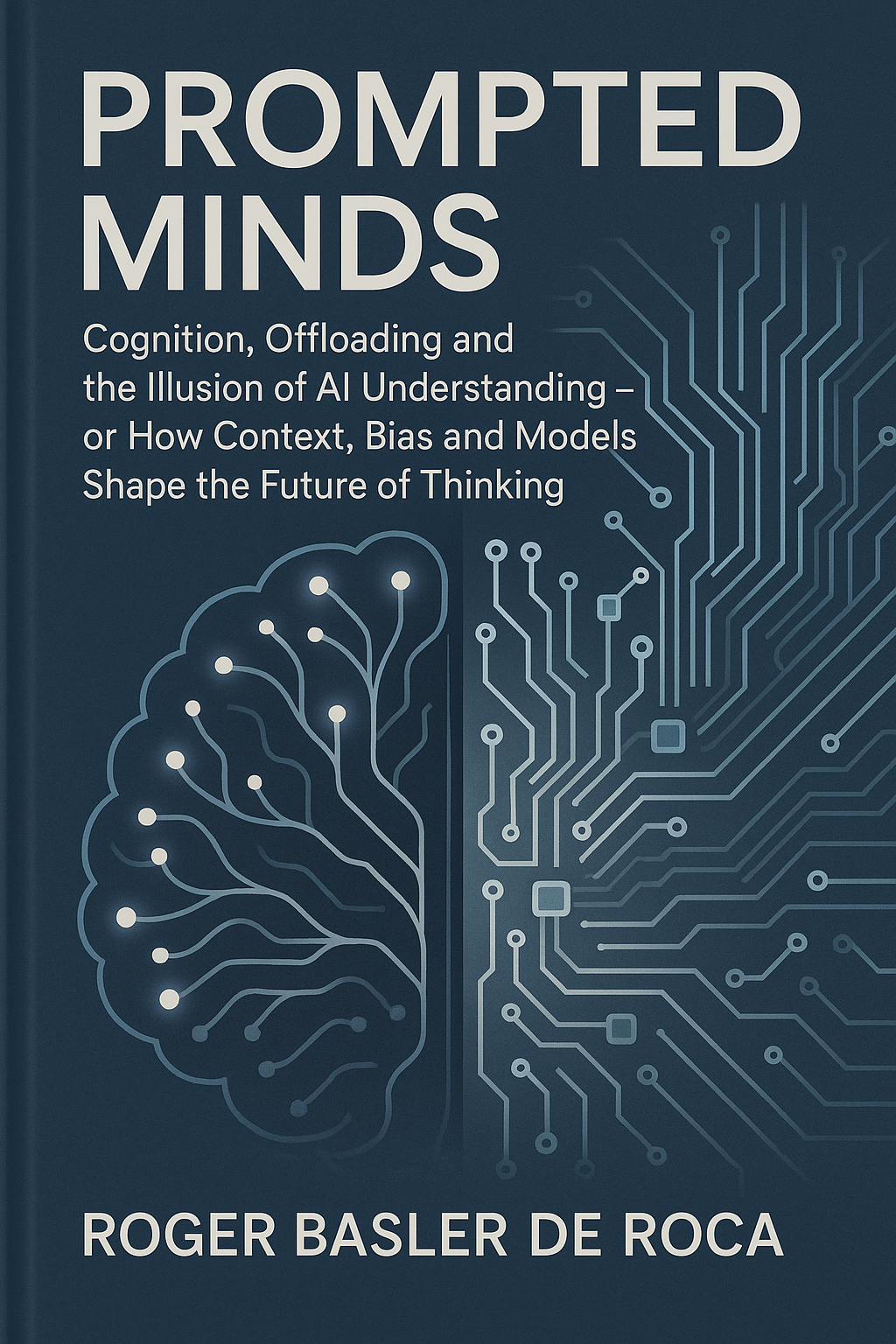
Cognition, Offloading and the Illusion of AI Understanding - or How Context, Bias and Models Shape the Future of Thinking
An analytic guide to what happens when human minds delegate thinking to fluent machines. Written in English by Roger Basler de Roca, it connects cognitive science, AI architecture, real-world failure cases, and practical frameworks for cognitive sovereignty.
Related upcoming English book: The Offloaded Mind, expanding on the empirical research tracked at offloading.fragroger.ai.
Listen & Read
Weekly essays on AI, human judgment, and cognitive offloading, also recorded as audio editions.
Concise briefings for leaders and practitioners navigating AI adoption without hype.
Two-host deep dives on one controversial AI topic, with new episodes every Wednesday and Sunday.
Living index of peer-reviewed studies, replications, and current evidence status on cognitive offloading.
Epilogue
You did not enter how many phone numbers you know by heart, yet most of us already know the answer. That memory went somewhere. Where will your thinking go?
The choice is ours, and the time to make it is now.
About the Author
Roger Basler de Roca is a Swiss AI consultant, keynote speaker, and author based in Zurich. He researches cognitive offloading (planned dissertation), delivers 100+ keynotes a year, and works with 60+ companies on practical AI implementation.
He lectures at HWZ, ZHAW, and FHNW, is a TEDx speaker, received the CONTRA Top Speaker Award in 2024 and 2025, has authored 14+ books, and speaks on stage in German, English, French, and Spanish.
"Artificial is the machine. Intelligence has to come from humans."
FAQ